
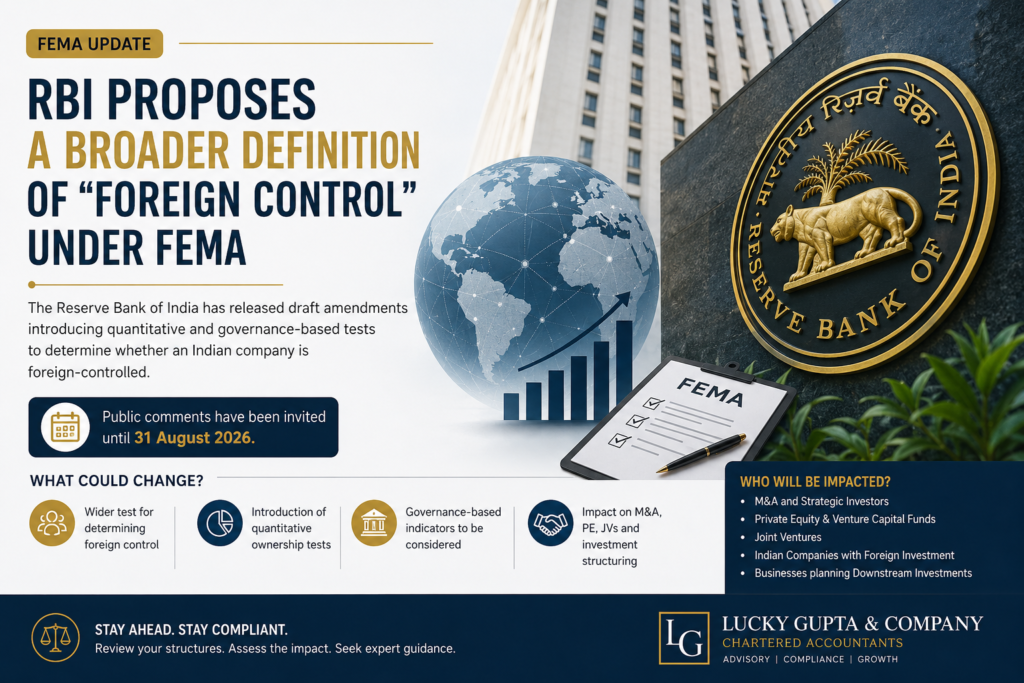
The Reserve Bank of India (RBI) has released draft amendments proposing a significant revision to the concept of “foreign control” under the Foreign Exchange Management Act (FEMA). If implemented, the revised framework could substantially influence how Indian companies are classified for foreign investment purposes and reshape the structuring of mergers and acquisitions (M&A), private equity investments, joint ventures, and cross-border transactions.
The RBI has invited public comments on the draft amendments until 31 August 2026, providing stakeholders with an opportunity to share their views before the changes are finalized.
Why Is This Proposal Important?
Under India’s foreign investment framework, determining whether an Indian company is considered foreign-controlled is critical. The classification affects compliance obligations, downstream investments, sectoral caps, reporting requirements, and the applicability of various FEMA regulations.
Historically, the determination of “control” has largely depended on qualitative factors such as the ability to appoint a majority of directors or exercise control over management or policy decisions through shareholding, agreements, or voting rights.
The proposed amendments seek to expand this assessment by introducing quantitative ownership thresholds alongside governance-based indicators, providing a broader and more comprehensive framework.
Key Highlights of the Draft Amendments
1. Wider Definition of Foreign Control
The RBI proposes moving beyond traditional tests of board control and management rights by incorporating additional indicators that may establish foreign control over an Indian entity.
This broader approach aims to capture situations where foreign investors possess significant influence despite not holding an outright majority stake.
2. Introduction of Quantitative Tests
The draft proposes measurable ownership-based criteria that may be considered while determining foreign control.
Such objective benchmarks could provide greater clarity but may also bring additional entities within the scope of foreign-controlled companies.
3. Governance-Based Indicators
Apart from shareholding, governance rights are expected to play an increasingly significant role.
Factors such as:
- Board appointment rights
- Reserved matters
- Veto rights
- Shareholder agreements
- Management participation
- Strategic decision-making authority
may collectively determine whether foreign investors effectively exercise control.
4. Impact on Existing Investment Structures
Many existing structures that currently qualify as Indian-controlled may require fresh evaluation once the revised framework becomes effective.
Companies may need to review shareholder agreements, governance rights, board composition, and investment arrangements.
Potential Business Implications
The proposed amendments could have wide-ranging implications across multiple sectors.
Mergers & Acquisitions (M&A)
Transaction structures may require reconsideration to ensure compliance with FEMA regulations. Investors and acquirers may need to evaluate whether governance rights could trigger foreign control.
Private Equity & Venture Capital
Investment documentation, shareholder rights, affirmative voting rights, and board representation clauses may need careful review during deal negotiations.
Joint Ventures
Indian and foreign joint venture partners may have to reassess governance arrangements to determine whether control continues to remain with Indian shareholders.
Downstream Investments
Entities classified as foreign-controlled are subject to specific FEMA rules governing downstream investments. A broader definition may alter compliance obligations for several corporate groups.
Corporate Governance
Companies may need to revisit constitutional documents, shareholders’ agreements, voting arrangements, and board structures to ensure alignment with the revised framework.
What Should Businesses Do?
Although the amendments are currently at the draft stage, businesses should begin assessing the possible impact on their existing structures.
Recommended steps include:
- Review shareholder agreements.
- Evaluate board composition and governance rights.
- Analyse affirmative voting and veto provisions.
- Examine downstream investment structures.
- Assess FEMA reporting obligations.
- Consult legal and financial advisors before restructuring investments.
Early preparedness can help businesses avoid compliance challenges once the revised regulations are notified.
Public Consultation
The RBI has invited comments from stakeholders until 31 August 2026. Businesses, industry bodies, professional firms, and investors have an opportunity to provide feedback on the proposed framework before it is finalized.
Conclusion
The RBI’s proposal represents one of the most significant developments in India’s foreign investment regulatory landscape in recent years. By introducing both quantitative and governance-based tests, the proposed amendments aim to provide a more comprehensive assessment of foreign control.
While the objective is to enhance regulatory clarity, businesses involved in cross-border investments, private equity transactions, mergers and acquisitions, and joint ventures should proactively evaluate the potential impact on their corporate structures.
Organizations should closely monitor the final notification and consider undertaking a detailed FEMA compliance review to ensure continued regulatory compliance.
Key Takeaways
- RBI has proposed a broader definition of “foreign control” under FEMA.
- Quantitative ownership tests and governance-based indicators are proposed.
- M&A, private equity, joint ventures, and foreign investment structures may be affected.
- Existing shareholder agreements and governance rights should be reviewed.
- Public comments are invited until 31 August 2026.
- Businesses should assess potential compliance implications before the amendments are finalized.
Frequently Asked Questions (FAQs)
What is the objective of the RBI’s proposed amendment?
The proposal aims to provide a broader and more comprehensive framework for determining whether an Indian company is considered foreign-controlled under FEMA.
Which businesses could be impacted?
Companies receiving foreign investment, startups, joint ventures, private equity-backed businesses, multinational subsidiaries, and entities making downstream investments may be affected.
Is the proposal currently applicable?
No. These are draft amendments released for public consultation. Final regulations will apply only after notification by the RBI.
Until when can stakeholders submit comments?
The RBI has invited public comments on the draft amendments until 31 August 2026.
Disclaimer: This article is intended for general informational purposes only and does not constitute legal, tax, or professional advice. Readers should seek professional guidance based on their specific facts and circumstances before making business or investment decisions.