
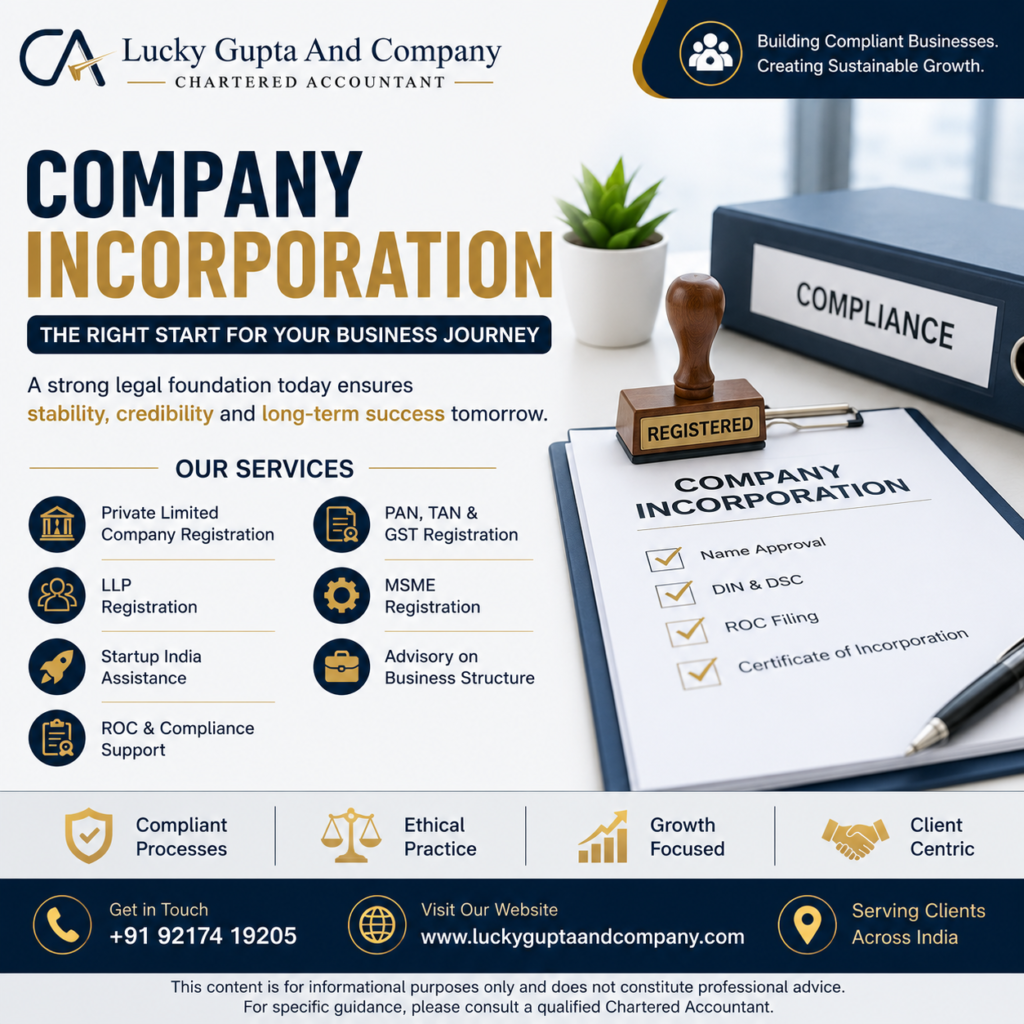
Starting a new business venture is an exhilarating milestone. You’ve got the vision, the market validation, and the drive to scale. But before you can issue your first invoice or hire your first employee, you face a foundational decision that will impact your business for years to come: company incorporation.
Choosing how to legally structure your business isn’t just a legal checkbox. It is a critical financial and strategic decision. The right setup can shield your personal assets, optimize your tax liabilities, and position you perfectly for future funding. The wrong one can burden you with unnecessary compliance costs or make investors run the other way.
Let’s break down the realities of company incorporation in simple terms, look at how it affects your bottom line, and help you determine the best path forward.
Why “Just Getting Started” Requires a Long-Term View
Many founders default to the simplest structure available, thinking, “I’ll change it later when we make money.” While transitions are possible, restructuring a live business can be expensive, time-consuming, and operationally disruptive.
When evaluating your incorporation options, you need to look through three distinct lenses:
- Liability Protection: Are your personal savings, home, and assets safe if the business faces a lawsuit or debt?
- Tax Efficiency: How will the business profits be taxed, and how can you legally optimize your personal take-home income?
- Capital Readiness: Do you plan to take on bank loans, venture capital, or angel investments?
A Strategic Note: Investors rarely invest in unregistered businesses or basic partnerships. If you plan to raise capital, a Private Limited Company is almost always the non-negotiable gold standard.
The Core Structures: Finding Your Match
Let’s look at the three most common paths for business owners, using practical scenarios to see how they play out in the real world.
1. Limited Liability Partnership (LLP)
An LLP gives you the structural benefits of a company but with the internal flexibility of a traditional partnership. It limits each partner’s liability to their agreed contribution.
- Best For: Professional service firms, consulting agencies, and lifestyle businesses with multiple co-founders who don’t intend to seek venture capital.
- The Financial View: Lower compliance costs compared to a Private Limited Company, and profits are distributed directly to partners without corporate dividend distribution taxes.
2. Private Limited Company (Pvt Ltd)
This is a completely separate legal entity from its owners. It offers robust liability protection and can easily issue shares to investors or employees (via ESOPs).
- Best For: Startups looking to scale rapidly, tech companies, businesses seeking institutional funding, or high-risk industries.
- The Financial View: Subject to corporate tax rates, which are often more favorable than individual tax slabs as your income grows. However, it requires mandatory annual audits and stricter regulatory filings.
3. One Person Company (OPC)
If you are a solo entrepreneur who wants the credibility of a corporate structure without the need for a co-founder, an OPC bridges the gap between a sole proprietorship and a corporate entity.
- Best For: Solo consultants, e-commerce single-operators, and specialized independent professionals.
Practical Case Study: The Cost of the Wrong Structure
Consider Aravind and Priya, who launched an e-commerce brand. In their first year, they operated as an unregistered partnership to save on initial costs. By year two, their revenue crossed ₹50 Lakhs, and they needed a ₹20 Lakh working capital loan to fulfill festive season inventory.
Because they lacked a formal corporate structure, banks requested personal guarantees, putting their personal properties at risk. Furthermore, they missed out on startup-specific tax exemptions because they hadn’t undergone formal company incorporation.
They formally transitioned to a Private Limited Company. This move not only secured the bank loan purely on the company’s credentials but also positioned them to raise angel funding six months later.
The Compliance & Financial Reality Checklist
While a formal structure unlocks growth, it also brings a baseline of regulatory responsibilities. Understanding these upfront prevents painful penalties later.
- The Corporate Tax Shield: Incorporating allows you to utilize legitimate business expenses—such as marketing, salaries, R&D, and equipment depreciation—to lower your net taxable income far more effectively than an individual tax filer can.
- Statutory Compliance: Companies must maintain pristine books of accounts, hold regular board meetings, and file annual financial statements with the Registrar of Companies (ROC).
- The CA’s Advice: Do not look at compliance as a burden; look at it as governance. Pristine financial records drastically increase the valuation of your company when you eventually look to exit or sell.
How We Can Help: Beyond the Paperwork
Many online platforms offer “one-click” company registration. However, they simply process forms without understanding your unique business dynamics.
At [Firm Name], we view company incorporation as the birth of a long-term financial strategy. We don’t just file your documents; we sit down with you to understand your 5-year roadmap.
Our Structural Onboarding Process Includes:
- Pre-Incorporation Advisory: Evaluating your funding goals and risk profile to select the exact right structure.
- End-to-End Registration: Handling name approvals, Digital Signature Certificates (DSC), Director Identification Numbers (DIN), and PAN/TAN allocations.
- Post-Incorporation Setup: Setting up corporate bank accounts, GST registration, and designing your initial accounting architecture so you are compliant from Day 1.
Let’s build your business on a rock-solid foundation. [Schedule a consultation with our corporate advisory team today] to discuss your incorporation strategy.
Frequently Asked Questions (FAQs)
1. How long does the company incorporation process typically take?
On average, once all clear documentation (ID proofs, address proofs, and signed forms) is submitted, the formal registration takes between 7 to 14 business days, depending on government processing timelines.
2. Can I convert my LLP into a Private Limited Company later?
Yes, you can convert an LLP into a Private Limited Company if your business needs change—such as needing to raise equity funding. However, the process involves specific regulatory approvals, stamp duty considerations, and restructuring of accounts. It is always more cost-effective to choose the right structure from the start if you foresee rapid scaling.
3. What are the minimum requirements to register a Private Limited Company?
You generally need a minimum of two directors (at least one must be a resident of the country) and two shareholders (who can be the same as the directors). You also require a registered office address to serve as the official location for government correspondence.
4. Is there a minimum capital requirement for company incorporation?
While historical rules mandated a strict minimum capital, current regulations have made it highly accessible, allowing you to start a company with nominal authorized capital (e.g., ₹1 Lakh or less depending on jurisdiction), meaning you don’t need a massive bank balance just to incorporate.
Disclaimer: The information provided in this article is for educational purposes only and does not substitute for personalized professional advice. Business laws vary by region and industry specifics.