
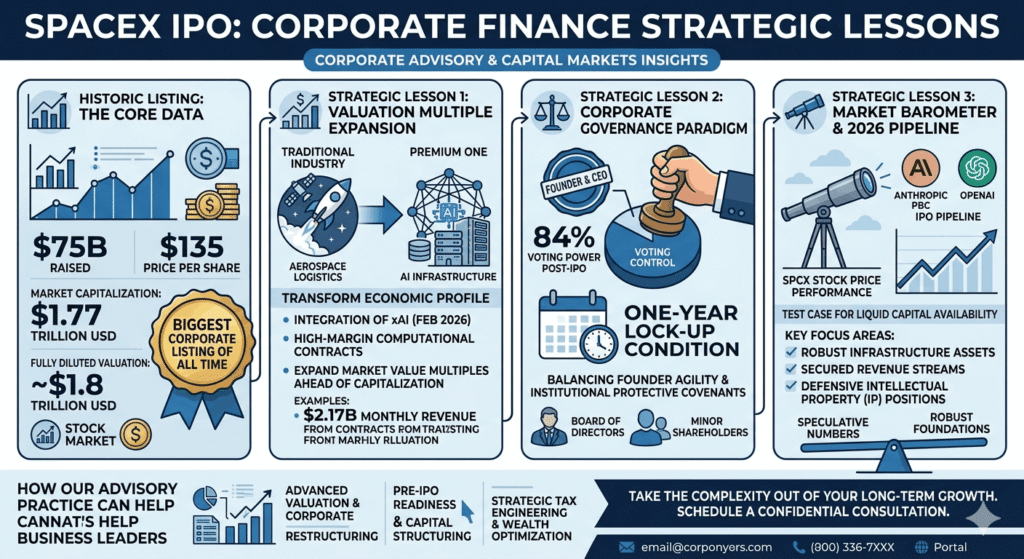
The global capital markets have just witnessed an unprecedented historical milestone. With its public debut under the ticker SpaceX IPO on the Nasdaq and Nasdaq Texas exchanges, SpaceX has successfully raised $75 billion by pricing 555.6 million shares at $135 each. This foundational event establishes an initial market capitalization of $1.77 trillion, making it the largest corporate listing of all time and positioning it at more than double the size of Saudi Aramco’s landmark 2019 debut.
While mainstream financial media focus extensively on the narrative of founder Elon Musk’s shifting paper net worth toward trillionaire status, sophisticated business owners and corporate executives must look deeper. Beyond the headlines, the underlying mechanics of the SpaceX IPO valuation offer clear, cross-industry blueprints for structural engineering, growth positioning, and corporate governance.
Decoding the Mechanics of the $1.77 Trillion SpaceX IPO Valuation
To evaluate a transaction of this magnitude with professional financial discipline, we must isolate the foundational raw figures from the speculative retail demand. Below is the verified breakdown of the initial structural offering:
| Financial Metric Element | Verified Structural Data Point |
|---|---|
| Base Capital Raised | $75.0 Billion USD |
| Initial Public Offering Share Price | $135.00 per Share |
| Base Volume of Shares Issued | 555.6 Million Class A Shares |
| Over-Allotment (Greenshoe) Allocation | 83.3 Million Shares (Potential +$11B Raise) |
| Core Market Capitalization Basis | $1.77 Trillion USD |
| Fully Diluted Equity Valuation | Approx. $1.80 Trillion USD |
The structural subscription metrics indicate that total demand exceeded the available pool by more than four times, led heavily by a retail order book that surpassed $100 billion. For an ambitious business scaling its operations toward a liquidity event, this massive demand underscores a critical reality: capital availability remains deeply concentrated in enterprises that successfully communicate a scalable infrastructure narrative.
Are You Mapping Your Long-Term Capital Strategy?
Whether preparing for an initial capital raise, restructuring existing debt, or planning a multi-year corporate transition, achieving premium market pricing requires precise structural design.Connect with our senior corporate finance advisors to evaluate your current institutional positioning and market readiness.
The Structural Pivot: A Masterclass in Valuation Multiple Expansion
A fundamental query arises for financial professionals: how does an asset-heavy aerospace organization that carries high capital expenses and historically volatile cash flows justify a tech-giant valuation multiple? The answer lies in its structural evolution.
By integrating xAI in February 2026, the corporation shifted its public positioning from a pure launch-and-satellite logistics firm to an essential artificial intelligence infrastructure provider. Highlighting recurring computation architecture agreements—such as contracts with major technology firms generating up to $2.17 billion monthly—allowed the business to transform its underlying economic profile.
The practical takeaway for mid-market business owners: Your valuation is not bound strictly by your historical industry classification. Through strategic corporate reorganization, intellectual property (IP) segregation, and the transition of variable revenue streams into contracted infrastructure models, you can radically expand your market value multiples ahead of a capitalization or sale process.
For growing enterprises executing similar multi-layered acquisitions or restructuring corporate groups, ensuring accurate financial reporting is paramount. Read our comprehensive [IFRS Consolidation Guide: Step-by-Step Process under IFRS 10 for Group Financial Statements] to master the compliance mechanics of complex group structures.
The Governance Paradigm: 84% Voting Control and Public Risk
From a strict corporate governance and compliance perspective, the structural design of this public listing presents a highly unconventional framework. The Chief Executive Officer retains 84% of the voting power post-IPO through concentrated Class B super-voting shares, accompanied by a strict one-year disposal lock-up condition.
While this framework grants the executive leadership team absolute freedom to pursue capital-intensive, long-horizon initiatives (such as non-Earth-based computational networks), it alters traditional public equity protections. Minor institutional shareholders are fully dependent on a single individual’s execution capabilities, effectively limiting the board’s capacity to enact independent corrective oversight.
When structuring early-stage equity plans or coordinating shareholder agreements for mid-sized entities, balancing founder operational agility with proper investor protective covenants is a delicate process. Proper structural allocation ensures that future rounds of capitalization do not encounter resistance from institutional funds that mandate standard governance architectures.
Strategic Implications for the Broader 2026 IPO Pipeline
The performance of the SPCX stock price serves as a critical macro indicator for the broader capital ecosystem. In an environment dealing with persistent inflationary markers and shifting cross-border geopolitical landscapes, this historic listing acts as a definitive stress-test for liquid capital availability.
With market participants closely monitoring upcoming pipelines for specialized entities like Anthropic PBC and OpenAI, mid-market businesses must understand that institutional capital remains active but discerning. The focus is shifting rapidly away from speculative customer acquisition numbers and returning firmly toward robust infrastructure assets, secured revenue streams, and defensive intellectual property positions.
Strategic Compliance Checkpoint
Is your financial reporting structure prepared to withstand sophisticated institutional due diligence? Our expert audit and advisory professionals help growing enterprises build transparent, compliant, and highly auditable financial operations. Request a comprehensive corporate wellness audit today.
Frequently Asked Questions (Financial & Strategic Advisory Perspective)
1. What were the core structural mechanics behind the SpaceX IPO valuation?
The entity listed public shares at $135 each, raising a baseline of $75 billion via 555.6 million shares. This structure established an initial market capital footprint of $1.77 trillion, supported by an additional 83.3 million share over-allotment cushion to absorb persistent institutional demand.
2. How does an asset-heavy aerospace firm secure premium tech-sector valuation multiples?
The key factor was the intentional combination with xAI and the optimization of high-margin computational infrastructure contracts. Transitioning volatile operational models into high-value B2B cloud and infrastructure revenue frameworks serves as an excellent case study for expanding valuation multiples across any industry tier.
3. What tax and equity considerations affect private stakeholders during a massive liquidity transition?
Liquidity events expose executive teams, early backers, and employees to substantial capital gains liabilities and complex equity settlement clauses. Proper pre-event structural design—including localized tax-advantaged holding structures and synchronized corporate distribution mechanisms—is essential to preserve asset value.
How Our Firm Navigates Complex Capital Strategies With You
You do not need to be managing a trillion-dollar aerospace enterprise to utilize high-level corporate finance principles. Our specialized accounting and advisory practice provides mid-sized enterprises, fast-growing startups, and high-net-worth business owners with the precise expertise required to optimize enterprise value and secure long-term financial stability.
Our comprehensive services are tailored to address your specific operational goals:
- Advanced Valuation & Corporate Restructuring: Structuring asset spin-offs, intellectual property holding divisions, and financial models designed to unlock higher market premiums.
- Pre-IPO Readiness & Capital Structuring: Developing rigorous compliance architectures, governance documentation, and internal audit reporting standards that satisfy discerning institutional investors.
- Strategic Tax Engineering & Wealth Optimization: Advising on specialized corporate tax reduction strategies, stakeholder liquidity events, and sophisticated multi-generational wealth preservation programs.
Schedule a Confidential Corporate Strategy Consultation
Take the complexity out of your long-term growth and capital planning. Contact our senior advisory partners today to explore how our tailored accounting, compliance, and corporate finance solutions can strengthen your market position.
- Email:
caluckygupta1@gmail.com - Phone:
+91 9217419205/9205835629 - Portal: https://luckyguptaandcompany.com/