
Introduction
The recent update in India’s citizenship framework has brought renewed attention to the Overseas Citizen of India (OCI) scheme. With the notification of the Citizenship (Amendment) Rules, 2026, the government has introduced changes aimed at simplifying processes and moving services online.
However, many people are still asking basic questions—what is an OCI card, who can apply, and what has actually changed in 2026?
This article breaks it down in a simple and practical way.
What is an OCI Card?
An OCI card is a form of long-term residency available to Persons of Indian Origin who are citizens of another country.
It is important to note:
- OCI is not full Indian citizenship
- It does not grant voting rights or political rights
- It allows visa-free travel and long-term stay in India
The scheme was introduced through amendments to the Citizenship Act, 1955 to strengthen ties with the Indian diaspora.
OCI Card Rules 2026: What Has Changed?
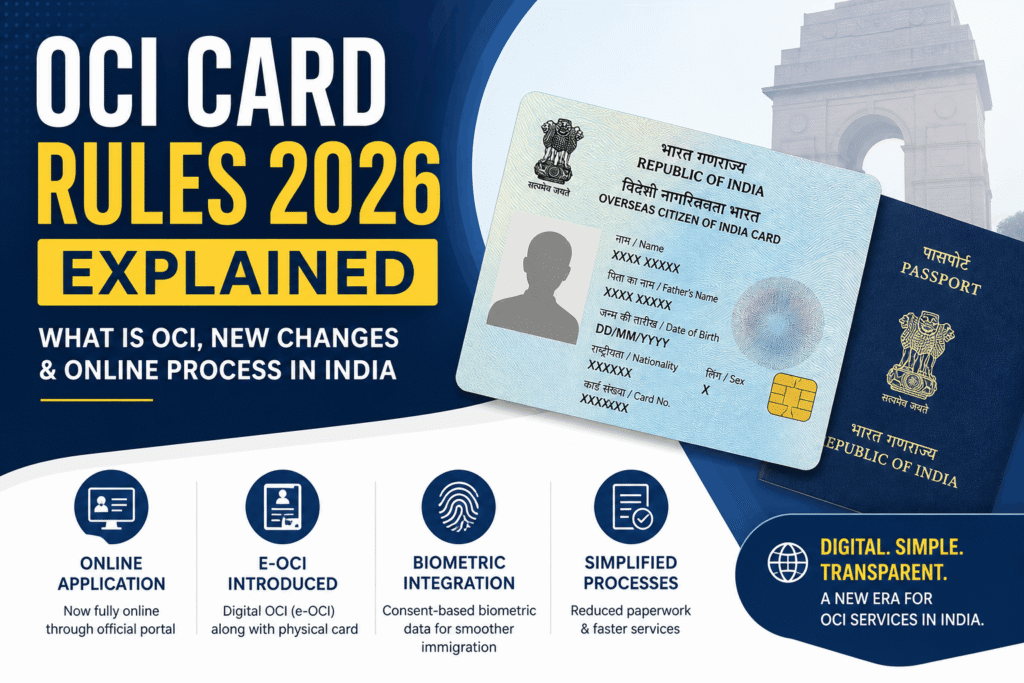
The OCI card rules 2026 mainly focus on digitisation and process clarity rather than changing eligibility.
Here are the key updates:
1. Fully Online Application Process
OCI applications are now expected to be handled entirely through the official online portal. This reduces dependency on physical submissions.
2. Introduction of e-OCI (Digital Record)
A digital version of OCI registration (e-OCI) has been introduced alongside the physical card.
This means:
- Records will be stored digitally
- Access and verification may become easier
3. Reduced Paperwork
Applicants may no longer need to submit duplicate physical documents in multiple stages.
However, certain documents may still be required where necessary.
4. Online Process for Renunciation & Cancellation
Processes such as surrender, cancellation, and renunciation of OCI status are now streamlined through digital systems.
5. Biometric Data Integration (Consent-Based)
Applicants may be required to provide consent for biometric data usage.
This could help integrate OCI services with immigration systems and enable faster processing in the future.
6. Structured Appeal Mechanism
Any appeal or review related to OCI decisions will be handled by a higher authority, improving procedural clarity.
Important Rule for Minors
One important clarification relates to minor children.
Under Indian law:
- A child holding an Indian passport cannot simultaneously hold a foreign passport
This is not a new concept but a reinforcement of existing legal provisions, as India does not allow dual citizenship.
Why These Changes Matter
At first glance, these updates may look procedural. However, they have practical implications:
- Faster application processing
- Reduced paperwork and delays
- Better record management
- Integration with immigration systems
In short, the focus is on making OCI services more efficient and structured.
Who Should Pay Attention?
These changes are particularly relevant for:
- NRIs and foreign citizens of Indian origin
- Families managing OCI status for children
- Individuals planning long-term stay or travel in India
Practical Insight
From a compliance perspective, the shift to digital systems also means:
- Documentation must be accurate and consistent
- Errors in applications may be tracked more easily
- Proper understanding of eligibility becomes important
Conclusion
The OCI card rules 2026 do not change the fundamentals of eligibility but significantly improve how the system operates.
The move towards digital processing reflects a broader push towards efficiency and transparency in government services.
Source
Reported by The Financial Express and other national media outlets.
Disclaimer
This article is for informational purposes only and does not constitute legal advice.
About Us
LUCKY GUPTA AND COMPANY – Chartered Accountant
We assist with:
- Regulatory compliance
- Documentation support
- Advisory on cross-border matters