
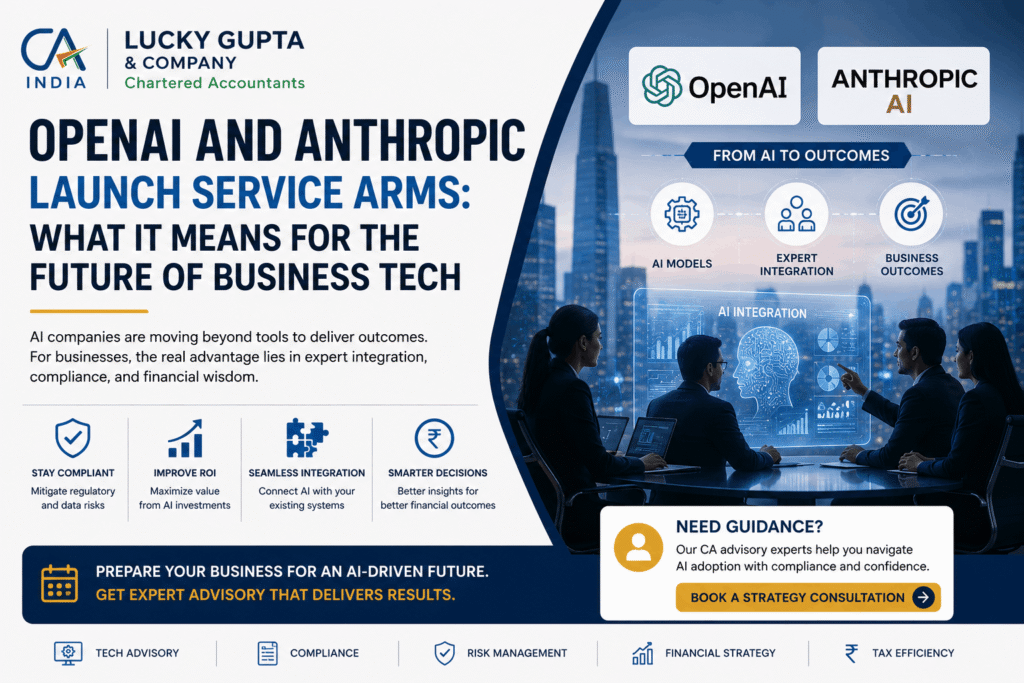
The artificial intelligence industry is rapidly moving beyond software tools.
AI companies are now entering the professional services space — a move that could reshape technology consulting, compliance management, automation advisory and enterprise operations globally.
Recent developments involving OpenAI and Anthropic indicate that AI providers are increasingly focusing not just on selling AI models, but also on helping businesses implement, integrate and operationalise AI systems.
For business owners, startups and finance teams, this shift raises important questions:
- Will AI replace traditional IT consulting?
- How will compliance and governance work?
- What risks arise from AI-led automation?
- When should businesses seek professional advisory support?
The answer is more practical than sensational.
AI can automate workflows, but businesses still require human expertise for compliance, financial oversight, risk management and implementation.
Why OpenAI and Anthropic Are Expanding Beyond AI Tools
Historically, AI companies focused on developing large language models (LLMs).
However, many businesses discovered that purchasing AI tools alone does not guarantee operational success.
Most companies struggle with:
- Data integration
- Security controls
- Financial workflow mapping
- Industry-specific compliance
- Legacy system compatibility
- Audit trail management
- Internal controls and governance
This “last-mile implementation problem” is where advisory and service-led models become important.
Businesses today do not simply want a chatbot.
They want:
- Faster reporting
- Automated reconciliations
- Better compliance tracking
- Improved cash flow visibility
- Reduced operational costs
- Smarter decision-making
This explains why AI firms are moving closer to service delivery and enterprise consulting.
Practical Example: AI in Financial Operations
Suppose a mid-sized company wants to automate invoice processing and compliance reviews using AI.
The technology itself may generate results quickly.
But several critical business questions still remain:
- Is financial data secure?
- Does the system comply with Indian laws?
- Are approvals properly documented?
- Can auditors verify AI-generated outputs?
- Is there a risk of incorrect tax reporting?
Without structured implementation and professional review, businesses may face operational and regulatory exposure.
This is where advisory professionals, finance experts and compliance consultants continue to play a critical role.
Is This a Threat to Indian IT and Advisory Firms?
Many reports suggest that AI companies entering the services market could disrupt traditional IT and consulting firms.
However, the practical reality is more balanced.
AI systems still require:
- Human supervision
- Business interpretation
- Compliance validation
- Financial analysis
- Process redesign
- Risk assessment
Technology alone cannot replace domain expertise.
In fact, the increasing complexity of AI adoption may create greater demand for professionals who understand both technology and business compliance.
Business Risks Companies Should Not Ignore
Many organisations are rushing into AI adoption without understanding the associated risks.
Key areas of concern include:
1. Data Privacy Risks
Sensitive financial and customer information may be exposed if systems are poorly configured.
2. Compliance & Audit Risks
AI-generated outputs may not always satisfy audit documentation standards.
3. Incorrect Financial Reporting
Automation errors can impact GST, TDS, payroll and management reporting.
4. Operational Dependency
Over-dependence on AI without review controls can create long-term governance issues.
5. Contractual & Vendor Risks
Businesses should carefully review agreements involving AI vendors, integrations and cloud-based systems.
Why Professional Advisory Matters More Than Ever
As businesses adopt AI-driven systems, financial and compliance oversight becomes increasingly important.
Professional advisors help businesses:
- Evaluate operational risks
- Maintain audit readiness
- Improve internal controls
- Structure compliance frameworks
- Assess technology ROI
- Ensure tax and reporting accuracy
AI implementation is no longer just a technology decision.
It is now a financial, compliance and governance decision.
Who Should Take Professional Help?
Professional guidance becomes especially important for:
✔ Businesses handling sensitive financial data
✔ Companies implementing AI in accounting or operations
✔ Startups scaling automation processes
✔ SMEs using cloud-based AI systems
✔ Businesses operating in regulated sectors
✔ Companies concerned about audit trails and compliance
When Should You Contact a Chartered Accountant or Advisor?
Businesses should seek professional assistance:
Before implementing AI systems
To evaluate tax, compliance and reporting impact.
Before major technology investments
To assess cost-benefit analysis and financial feasibility.
During automation restructuring
To ensure proper controls and governance frameworks.
Before audit or regulatory reviews
To maintain proper documentation and compliance readiness.
Practical Business Insight
Many businesses currently view AI adoption purely as a software upgrade.
In reality, the larger challenge lies in:
- Governance
- Risk management
- Financial controls
- Compliance monitoring
- Process accountability
The companies that succeed with AI will not necessarily be those using the most advanced tools.
They will be the businesses that implement AI with proper oversight, structured controls and professional guidance.
Need Professional Guidance for AI-Driven Business Transformation?
Businesses adopting automation and AI systems should ensure that financial reporting, compliance processes and governance frameworks remain secure and audit-ready.
Professional advisory support can help organisations evaluate:
- Compliance exposure
- Process automation risks
- Financial reporting controls
- Technology investment decisions
- AI governance structures
Early planning often helps businesses avoid operational and compliance issues later.
Also Read :
- GST Registration in India
- IFRS Consolidation Guide
- Transfer pricing guide
- New Income tax Act 2025
- Udyam Registration Delhi NCR
Conclusion
The expansion of OpenAI and Anthropic into service-led business models signals an important shift in the global technology ecosystem.
AI tools alone are no longer enough.
Businesses now require implementation support, governance frameworks, compliance validation and financial oversight.
This creates significant opportunities for advisory professionals, compliance experts and finance-focused consultants who can bridge the gap between technology and business execution.
For companies adopting AI, the focus should not only be automation.
It should also be accuracy, accountability and sustainable compliance.
Frequently Asked Questions (FAQ)
1. Why are OpenAI and Anthropic entering the services market?
AI companies are increasingly helping businesses implement and integrate AI systems because many organisations struggle with operational deployment and compliance.
2. Will AI replace consulting and advisory firms?
AI may automate repetitive work, but businesses still require professional expertise for compliance, financial review, governance and strategic implementation.
3. What are the biggest risks of AI implementation?
Key risks include data privacy issues, incorrect reporting, lack of audit trails, compliance failures and operational dependency.
4. Should SMEs seek professional help before AI adoption?
Yes. SMEs often lack structured internal controls, making professional guidance important during AI implementation.
5. Can AI impact financial compliance?
Yes. AI systems can affect accounting, reporting, payroll, GST, TDS and audit documentation if not properly monitored.