
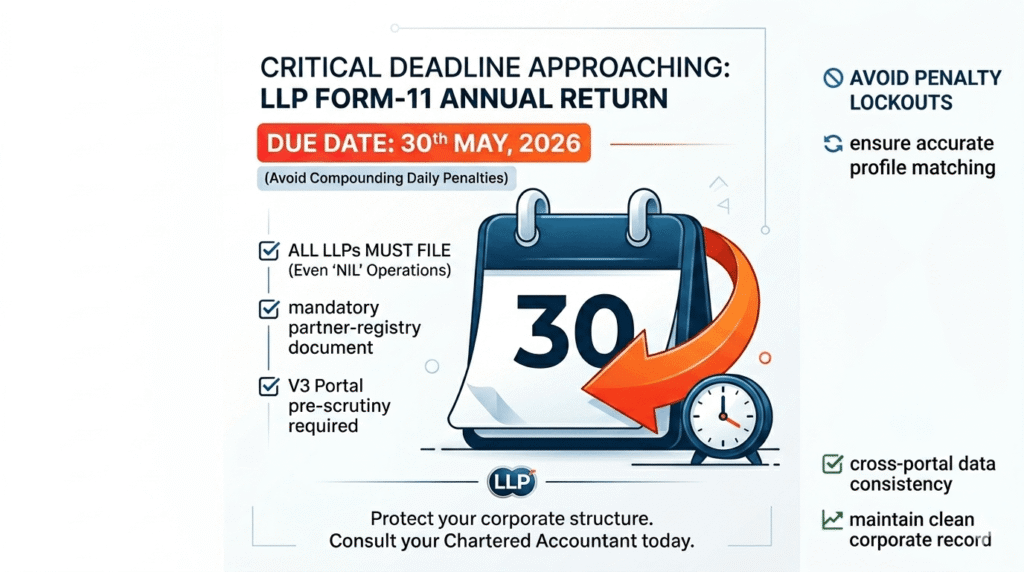
For founders, promoters, and managing partners operating a Limited Liability Partnership (LLP) in India, the month of May introduces a critical statutory milestone. Far too often, early-stage enterprises and mid-market companies treat annual filings as low-priority administrative tasks.
However, under the current regulatory landscape enforced by the Ministry of Corporate Affairs (MCA), a minor delay or data discrepancy in your LLP Form 11 compliance can result in severe financial penalties and structural disruptions.
With the statutory deadline of May 30th arriving rapidly, managing partners must look closely at their compliance architecture. Form 11—the mandatory Annual Return of an LLP—is not merely an exercise in paperwork; it is a critical disclosure of your entity’s ownership, management structure, and partner capital obligations as of the close of the financial year.
Understanding the risks of non-compliance, navigating the technical nuances of the MCA V3 portal, and knowing when your entity requires professional sign-offs are vital steps to preserving your operational health.
Regulatory Security is the Foundation of Corporate Valuation. True compliance management isn’t about racing to beat a midnight deadline; it’s about maintaining a clean corporate record that builds institutional trust with banks, investors, and vendors. Our partner-led corporate regulatory compliance services provide complete data pre-scrutiny, DSC registration, and error-free execution for growing Indian enterprises. 👉 [Schedule a Statutory Compliance Review with Our Corporate Advisory Team]
The Critical Risk Factors of LLP Form 11 Compliance
From a professional audit and financial perspective, Form 11 carries unique statutory attributes that differ significantly from standard corporate income tax filings. Failing to recognize these differences can expose partners to severe personal liabilities and corporate disruptions.
1. The “Nil-Operation” Misconception
The most common and expensive mistake made by business owners is assuming that a dormant or zero-revenue LLP is exempt from filing.
Statutory Rule: Form 11 is an establishment-level registry document under Section 35 of the LLP Act, 2008. It is completely independent of your commercial turnover, profit, or loss. Even if your business did not execute a single commercial transaction during the entire financial year, filing a mandatory “NIL” Annual Return is legally non-negotiable.
2. The Compounding, Uncapped Penalty Structure
Unlike many corporate tax frameworks that cap late fees at a specific ceiling, the penalty for delaying your LLP Annual Return filing is designed to accumulate indefinitely. Missing the May 30th deadline triggers an additional filing fee that grows day by day until the compliance failure is formally rectified.
Beyond the immediate cash outflow, prolonged default gives the Registrar of Companies (ROC) the statutory authority to flag your entity as “defaulter,” initiate strike-off proceedings, dissolve the business, and disqualify the designated partners from holding positions in any other Indian company or LLP for five years.
Navigating the MCA V3 Portal and Structural Thresholds
Since the transition of corporate filings to the upgraded MCA V3 web-based portal, compliance management has shifted from a manual data-entry process to a dynamic database integration. This shift requires absolute precision across your corporate records.
Common Pitfalls in Data Integration
- Unsynchronized Profile Data: The V3 portal auto-populates critical master data directly from your previous filings. If there is an unresolved discrepancy between a partner’s PAN, Aadhaar, or Director Identification Number (DIN) records, the pre-fill validation will fail, blocking your ability to submit.
- Pending Form 4 Submissions: If your LLP underwent management changes during the financial year—such as the resignation or appointment of a partner—and the corresponding Form 4 was not uploaded or has unpaid fees, the portal will systematically block the submission of Form 11.
Understanding the Corporate Governance Thresholds
The law introduces explicit checkpoints where an LLP transitions from internal signing to mandatory professional oversight:
- Internal Partner Sign-off: If your LLP’s total capital contribution remains under ₹50 Lakhs AND your annual turnover stays under ₹5 Crores, the return can be finalized using the Digital Signature Certificates (DSC) of two designated partners.
- Mandatory Professional Certification: The moment your entity crosses either threshold—a contribution exceeding ₹50 Lakhs OR an annual turnover exceeding ₹5 Crores—Form 11 cannot be processed without formal certification from a practicing Company Secretary (CS).
(Internal Linking Suggestion: If your company is scaling toward these operational limits, review our master structural analysis on [Navigating LLP Statutory Audit Thresholds and Advanced Corporate Governance] to ensure your financial tracking is fully aligned with MCA expectations).
Avoid Portal Lockouts and Compliance Penalties. Server congestion and technical validation errors on the MCA V3 portal frequently disrupt last-minute attempts to file. Our dedicated team handles end-to-end data reconciliation, ensuring your partner capital records match previous filings perfectly. 👉 [Connect with Our Compliance Experts for Secure LLP Filing Support]
Practical Case Study: The Multi-Form Dependency Trap
To understand why precision matters, consider the real-world operational risk of the Multi-Form Dependency Trap.
A successful logistics LLP based in Mumbai attempted to file their Form 11 on their own using the web-based portal. Due to a minor technical oversight during data entry, they mistakenly entered the partner’s obligated capital contribution as zero, ignoring the active figures listed in their LLP Agreement. The form was uploaded, the system processed it, and the internal team assumed their compliance duties were complete.
Five months later, in October, the LLP attempted to file Form 8 (the mandatory Statement of Account & Solvency).
The MCA V3 portal instantly blocked the submission. Why? Because the financial balance sheet figures entered in Form 8 did not match the partner capital data that had been hardcoded into the system by the faulty Form 11 filed in May.
Because there is no simple online mechanism for a user to revise a finalized Form 11, the company was forced to file formal service requests to cancel the original submission, facing mounting daily late fees for Form 8 while waiting for a resolution.
This operational friction highlights why a professional, comprehensive pre-scrutiny process is vital.
Frequently Asked Questions (FAQs)
What is the exact difference between LLP Form 11 and Form 8?
Form 11 is the Annual Return of the LLP, focusing purely on statutory management data, partner identities, and capital obligations. It is due by May 30th. Form 8 is the Statement of Account & Solvency, which captures the actual financial records, balance sheets, and declarations of profitability of the entity. Form 8 is due later in the corporate compliance calendar, on October 30th.
Our LLP was incorporated in January 2026. Are we legally required to file Form 11 by May 30, 2026?
According to MCA guidelines, if an LLP is incorporated on or after October 1st of a given financial year, its first financial year can extend to March 31st of the following calendar year. Therefore, an LLP registered in January 2026 is not statutorily required to file Form 11 by May 30, 2026. Its initial mandatory filing window will open in May 2027, covering the extended period from incorporation through March 31, 2027.
Can a partner be held personally responsible if an LLP defaults on its annual filings?
Yes. Under the LLP Act, while partners enjoy limited liability for business debts, the Designated Partners bear direct statutory responsibility for ensuring the entity meets all regulatory deadlines. Continued failure to comply can result in criminal penalties, legal notices from the ROC, and a 5-year disqualification that blocks the individual from acting as a director or partner in any Indian business enterprise.
Secure Your Corporate Standing with Professional Advisory
Enterprise value is built on clean compliance records, transparent governance, and operational resilience. As the statutory deadline approaches, relying on automated tools or unverified inputs leaves your company exposed to administrative errors and unexpected financial liabilities.
Our established professional corporate advisory firm pairs deep regulatory knowledge with smooth execution on the MCA V3 portal. We ensure your statutory returns match your corporate agreements perfectly, protecting your business from portal blocks and late fees.
Ensure your entity is fully protected before May 30th.
📞 [Book a Statutory Compliance Consultation with Our Senior Partners +91 9205835629/9217419205]
📩 [Inquire Directly Regarding Corporate Compliance & Retainer Services – caluckygupta1@gmail.com]