
📌 Introduction
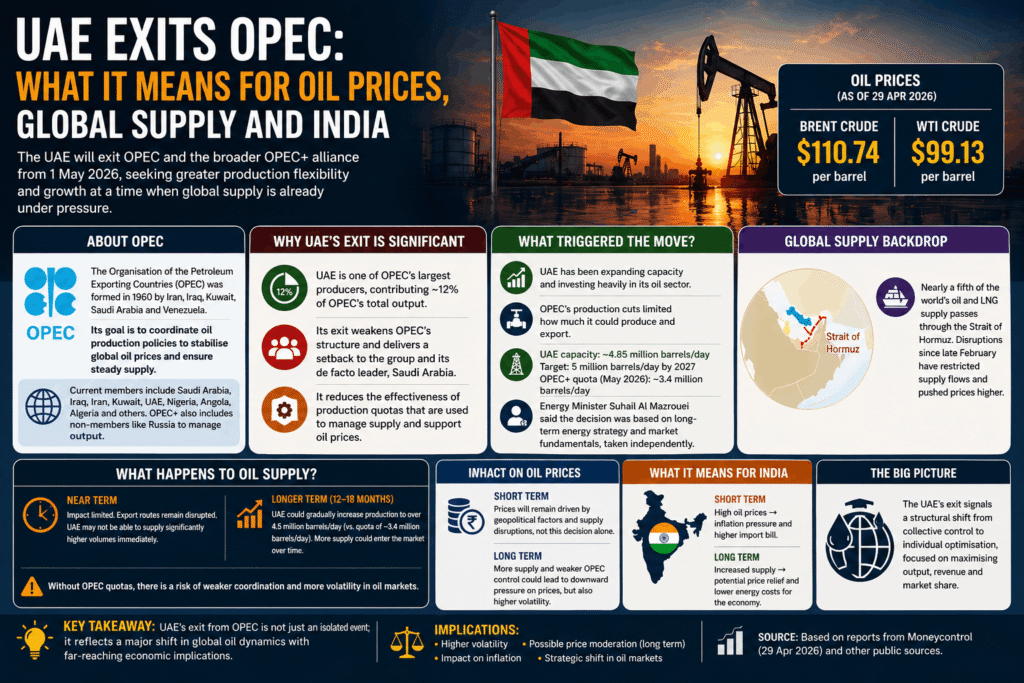
The decision by the United Arab Emirates to exit OPEC and the broader OPEC+ alliance marks a significant shift in global oil markets.
The exit will take effect from 1 May 2026, at a time when oil prices are already elevated and global supply remains under pressure.
📊 Key Data at a Glance
- UAE contributes ~12% of OPEC’s total output
- Brent crude: ~$110 per barrel
- WTI crude: ~$99 per barrel
- UAE capacity: ~4.85 million barrels/day (target 5 mbpd by 2027)
- OPEC quota for UAE: ~3.4 mbpd
👉 This gap between capacity and quota is central to the decision.
🔍 Why UAE Exited OPEC
The move is primarily driven by production flexibility.
For years, OPEC has controlled supply through production quotas. However, the UAE has been expanding its production capacity.
Therefore, continuing under strict quotas limited its ability to maximise output and revenue.
👉 In simple terms:
Higher capacity + lower quota = incentive to exit
⚠️ Why This Exit is Significant
1. Weakening of OPEC Control
OPEC relies on coordinated production cuts to stabilise prices. However, with a major producer exiting, this control weakens.
2. Risk of Further Exits
Other countries with growing capacity may reconsider their position if quotas limit growth.
3. Timing Amid Global Tensions
The exit comes when global supply is already tight due to disruptions around key shipping routes such as the Strait of Hormuz.
👉 Therefore, even a structural change can have amplified impact.
📉 Short-Term Impact on Oil Supply
In the near term, the impact is expected to be limited.
This is because:
- Supply chains are already disrupted
- Export capacity remains constrained
👉 Even if UAE increases production, it may not immediately translate into higher global supply.
📈 Long-Term Impact on Oil Markets
Over time, the situation may change.
- UAE could gradually increase production over 12–18 months
- Additional supply may enter the market
- OPEC’s ability to control prices may reduce
👉 This creates two possible outcomes:
- Downward pressure on prices (due to higher supply)
- Increased volatility (due to weaker coordination)
🧠 Impact on Oil Prices
Short Term
Prices will likely remain influenced by geopolitical factors rather than this decision alone.
Long Term
If supply increases and coordination weakens:
- Prices may stabilise or decline
- However, volatility may increase
🇮🇳 What It Means for India
For India, which relies heavily on oil imports, the impact is mixed.
Short Term
- High oil prices → Inflation pressure
- Increased import costs
Long Term
- Increased supply → Potential price relief
- Lower energy costs for the economy
👉 Therefore, the long-term outlook could be more favourable.
🧠 Structural Shift in Global Oil Markets
This move reflects a broader change in strategy.
Earlier, oil-producing nations focused on collective control. Now, there is a shift towards:
- Maximising individual output
- Increasing revenue
- Expanding market share
👉 This signals a move from coordination to competition
⚖️ Conclusion
The UAE’s exit from OPEC is not just an isolated event. It represents a structural shift in global oil markets.
While the short-term impact may be limited, the long-term effects could reshape supply dynamics, pricing mechanisms, and market stability.
⚠️ Disclaimer
This article is for informational purposes only and is based on publicly available data.
📌 Introduction
The decision by the United Arab Emirates to exit OPEC and the broader OPEC+ alliance marks a significant shift in global oil markets.
The exit will take effect from 1 May 2026, at a time when oil prices are already elevated and global supply remains under pressure.
📊 Key Data at a Glance
- UAE contributes ~12% of OPEC’s total output
- Brent crude: ~$110 per barrel
- WTI crude: ~$99 per barrel
- UAE capacity: ~4.85 million barrels/day (target 5 mbpd by 2027)
- OPEC quota for UAE: ~3.4 mbpd
👉 This gap between capacity and quota is central to the decision.
🔍 Why UAE Exited OPEC
The move is primarily driven by production flexibility.
For years, OPEC has controlled supply through production quotas. However, the UAE has been expanding its production capacity.
Therefore, continuing under strict quotas limited its ability to maximise output and revenue.
👉 In simple terms:
Higher capacity + lower quota = incentive to exit
⚠️ Why This Exit is Significant
1. Weakening of OPEC Control
OPEC relies on coordinated production cuts to stabilise prices. However, with a major producer exiting, this control weakens.
2. Risk of Further Exits
Other countries with growing capacity may reconsider their position if quotas limit growth.
3. Timing Amid Global Tensions
The exit comes when global supply is already tight due to disruptions around key shipping routes such as the Strait of Hormuz.
👉 Therefore, even a structural change can have amplified impact.
📉 Short-Term Impact on Oil Supply
In the near term, the impact is expected to be limited.
This is because:
- Supply chains are already disrupted
- Export capacity remains constrained
👉 Even if UAE increases production, it may not immediately translate into higher global supply.
📈 Long-Term Impact on Oil Markets
Over time, the situation may change.
- UAE could gradually increase production over 12–18 months
- Additional supply may enter the market
- OPEC’s ability to control prices may reduce
👉 This creates two possible outcomes:
- Downward pressure on prices (due to higher supply)
- Increased volatility (due to weaker coordination)
🧠 Impact on Oil Prices
Short Term
Prices will likely remain influenced by geopolitical factors rather than this decision alone.
Long Term
If supply increases and coordination weakens:
- Prices may stabilise or decline
- However, volatility may increase
🇮🇳 What It Means for India
For India, which relies heavily on oil imports, the impact is mixed.
Short Term
- High oil prices → Inflation pressure
- Increased import costs
Long Term
- Increased supply → Potential price relief
- Lower energy costs for the economy
👉 Therefore, the long-term outlook could be more favourable.
🧠 Structural Shift in Global Oil Markets
This move reflects a broader change in strategy.
Earlier, oil-producing nations focused on collective control. Now, there is a shift towards:
- Maximising individual output
- Increasing revenue
- Expanding market share
👉 This signals a move from coordination to competition
⚖️ Conclusion
The UAE’s exit from OPEC is not just an isolated event. It represents a structural shift in global oil markets.
While the short-term impact may be limited, the long-term effects could reshape supply dynamics, pricing mechanisms, and market stability.
⚠️ Disclaimer
This article is for informational purposes only and is based on publicly available data.
Source : IndiaToday