For modern corporate executives and business founders, maintaining structural alignment with regulatory frameworks isn’t simply a statutory requirement—it is a cornerstone of operational health and corporate credibility. Under the aegis of the Ministry of Corporate Affairs (MCA) and the Companies Act, 2013, governance requirements have undergone a profound shift. What once operated as a routine administrative function has matured into an active enforcement ecosystem where data transparency is paramount.
As we navigate the ROC Compliance Calendar FY 2026-27, proactive planning is crucial. The current regulatory environment leaves very little margin for administrative oversight. Missing a statutory deadline triggers automated penalties and flags your entity within corporate intelligence databases, signaling potential vulnerability to financial institutions, investors, and vendors.
This guide breaks down the essential compliance obligations for the upcoming fiscal cycle into clear, operational milestones, helping you protect your organization from structural disruptions and unnecessary overheads.
Is your business fully insulated against automated MCA compliance penalties? Regulatory frameworks shouldn’t detract from your primary focus: core business scaling. Our dedicated Corporate Secretariat division provides end-to-end management of your statutory requirements. 👉Schedule a compliance review with our partner team today.
1. The Bedrock of Annual Filing: Trigger-Based Corporate Milestones
Most annual statutory filings are anchored to the scheduling of your Annual General Meeting (AGM). Following the conclusion of the financial year on March 31, 2026, corporate entities are bound by strict legal timelines that determine filing sequences.
Rather than viewing these as independent deadlines, successful management teams look at them as a domino effect: once your AGM is finalized, the clocks for financial and administrative reporting start ticking simultaneously.
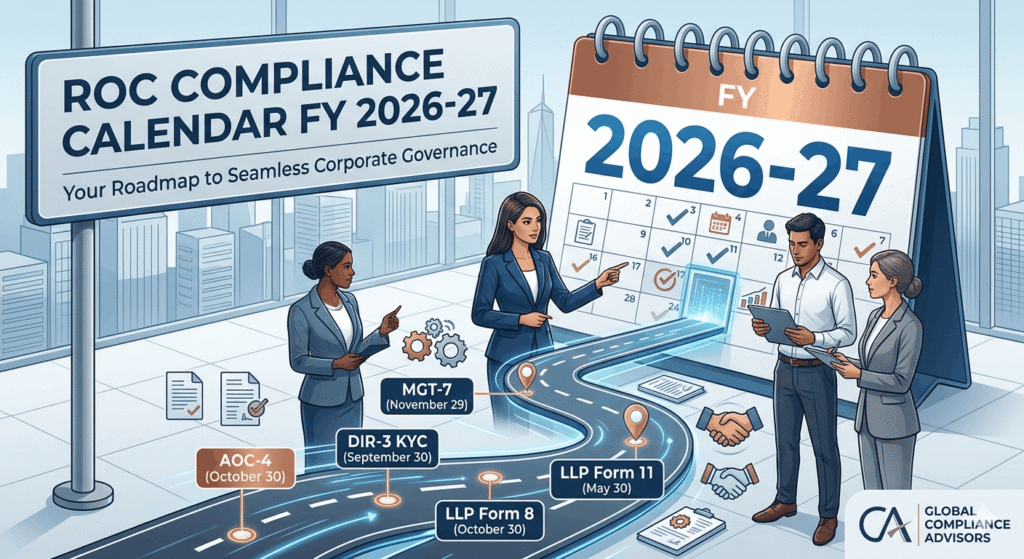
| Statutory Form | Scope & Structural Purpose | Applicable Entity | Statutory Due Date (FY 2026-27) |
|---|---|---|---|
| Form MSME-1 (H2) | Mandatory half-yearly disclosure reporting outstanding payments exceeding 45 days to verified micro and small enterprises. | Specified Corporate Entities | April 30, 2026 (For Oct ’25 – Mar ’26 period) |
| Form DPT-3 | Annual return detailing deposits and/or loans, advances, and credit receipts not categorized as deposits. | All Companies (except Govt Entities) | June 30, 2026 |
| Form DIR-3 KYC | Annual identity and electronic verification of active Director Identification Numbers (DIN/DPIN). | All DIN/DPIN Holders | September 30, 2026 |
| Form ADT-1 | Official notification to the Registrar regarding the formal appointment or ratification of Statutory Auditors. | All Companies | October 14, 2026 (Within 15 days of the AGM) |
| Form AOC-4 / XBRL | Submission of Audited Financial Statements, Directors’ Report, and the Independent Auditor’s Report. | All Companies (Excl. OPC) | October 30, 2026 (Within 30 days of the AGM) |
| Form MSME-1 (H1) | Half-yearly return tracking overdue balances to MSME vendors for the April-to-September period. | Specified Corporate Entities | October 31, 2026 (For Apr ’26 – Sep ’26 period) |
| Form MGT-7 / 7A | The official Annual Return detailing shareholding patterns, structural changes, and promoter profiles (7A applies to Small/OPC entities). | All Companies / Small Entities | November 29, 2026 (Within 60 days of the AGM) |
💡 Operational Case Study: The Danger of the Trailing Deadline
Consider a mid-scale logistics corporation that hosted its AGM early, on September 25, 2026. Instead of using the absolute calendar cutoff of October 30, their specific compliance countdown for Form AOC-4 begins exactly on the day after the AGM. Therefore, their specific deadline shifts forward to October 25, 2026. Missing this timeline by just five days results in automated, non-negotiable additional fees of ₹500 per director/form, alongside an internal flag in the MCA system.
2. Limited Liability Partnerships (LLPs): Calendar-Based Trajectories
Unlike traditional corporate entities, LLPs operate on fixed calendar timelines that are independent of internal meeting dates. This structural predictability can sometimes lead to administrative complacency, making rigorous adherence to the ROC Compliance Calendar FY 2026-27 highly critical.
- LLP Form 11 (Annual Return): Contains structural summaries of partner contributions and management changes. This form must be filed within 60 days of the fiscal close.
- Statutory Cutoff: May 30, 2026
- LLP Form 8 (Statement of Account & Solvency): A structured financial declaration detailing asset allocation, liabilities, and debt-servicing capabilities. This form must be submitted within 30 days of the conclusion of the first six months of the financial year.
- Statutory Cutoff: October 30, 2026
Are you treating corporate governance as a reactive checklist or a strategic asset? Lapses in statutory documentation create complications during institutional debt processing, equity funding rounds, and external structural audits. Our senior advisors manage corporate compliance seamlessly, allowing you to focus completely on enterprise growth. 👉Connect with our Compliance Advisory Team to build your secure corporate calendar.
3. Structural Shifts: Event-Driven Compliances
While annual returns follow a predictable schedule, your business operations will occasionally require internal structural changes. These events activate immediate disclosure rules outside the standard annual reporting cycle. In corporate practice, these are known as event-based compliances.
- Altering the Registered Office (Form INC-22): Must be executed within 15 days of adopting the board resolution to ensure corporate transparency for external stakeholders.
- Changes in Board Composition or KMPs (Form DIR-12): Any appointment, resignation, or structural shift in executive designation must be submitted within 30 days to protect against director liability issues.
- Fresh Capital Allotment (Form PAS-3): A detailed return of allotment must be registered within 30 days of fund allocation before issuing physical or digital share certificates.
- Secured Debt Creation or Modification (Form CHG-1): Registration of banking or institutional charges must occur within 30 days to ensure proper collateral mapping in the public register.
4. The True Cost of Non-Compliance: A Financial and Risk Analysis
The Ministry of Corporate Affairs uses a standardized, automated fee engine. For standard filing delays, a flat additional fee of ₹100 per day per form accumulates automatically without requiring manual review by the Registrar. For an organization missing three baseline forms for two months, this additional administrative cost can easily surpass ₹18,000.
Beyond the direct financial costs, non-compliance introduces operational risks that are far more damaging to enterprise value:
- Restricted Access to Capital: Institutional lenders and venture capital firms require a clean compliance certificate from the MCA portal before initiating debt drawdowns or equity disbursements.
- Director Defaulter Status: Continuous negligence over multiple cycles can lead to the disqualification of director DINs under Section 164(2) of the Companies Act, 2013, disrupting management structures across other connected business entities.
- Commercial Friction: Enterprises routinely perform automated counterparty risk assessments during large-scale procurement processes. An “Active-Non-Compliant” flag on the public registry can immediately disqualify your firm from high-value corporate tenders.
Strategic Execution: How We Protect Your Corporate Standings
In a sophisticated corporate landscape, compliance management should not be a fragmented, end-of-year scramble. It requires professional oversight that aligns with your broader financial and business objectives.
Our professional CA advisory firm moves your business from a reactive stance to structured, proactive governance. We deploy a multi-tiered framework designed for absolute accuracy:
- Automated Compliance Calendars: Customized to your corporate architecture, ensuring internal tracking milestones are met long before public cutoffs.
- Rigorous Secretarial Audits: Comprehensive validation of internal registers, board resolutions, and filing documents prior to official MCA submission.
- Integrated Financial Accounting: Ensuring perfect data reconciliation between statutory financial records, direct/indirect tax filings, and corporate disclosures.
🏢 Take Control of Your Regulatory Framework
Don’t wait for fiscal deadlines to discover operational inconsistencies or compliance gaps. Partner with our corporate advisory and secretarial team to secure your business’s legal standing for the entire year. 👉Request a Comprehensive Statutory Health Check and Consultation Clear of Administrative Stress →
Frequently Asked Questions (FAQs)
1. What is the standard financial penalty for missing an ROC due date in FY 2026-27? Under the updated guidelines of the Companies Act, the standard statutory penalty is a non-negotiable additional fee of ₹100 per day per delayed form. This charge accrues automatically until the finalized form is successfully submitted on the MCA portal.
2. Can an organization file Form AOC-4 and MGT-7 without conducting an AGM? No. Financial balance sheets and corporate returns require formal approval and adoption by shareholders during an AGM. Attempting to file these documents without holding a valid meeting breaks statutory procedures and can lead to structural regulatory reviews.
3. What qualifies a corporation as a “Small Company” for the FY 2026-27 filing cycle? Under the current legal definitions, an enterprise qualifies as a “Small Company” if its paid-up capital does not exceed ₹10 Crore and its turnover does not exceed ₹100 Crore. These entities benefit from streamlined compliance requirements, including the use of the simplified Form MGT-7A and exemptions from cash flow statements.
4. How can business owners verify if their current Director Identification Number (DIN) is compliant? Directors must ensure their Form DIR-3 KYC is updated annually by September 30. If missed, the DIN status changes to ‘KYC Non-Compliant’ on the public index, which deactivates the account and prevents the individual from executing any structural corporate filings.